
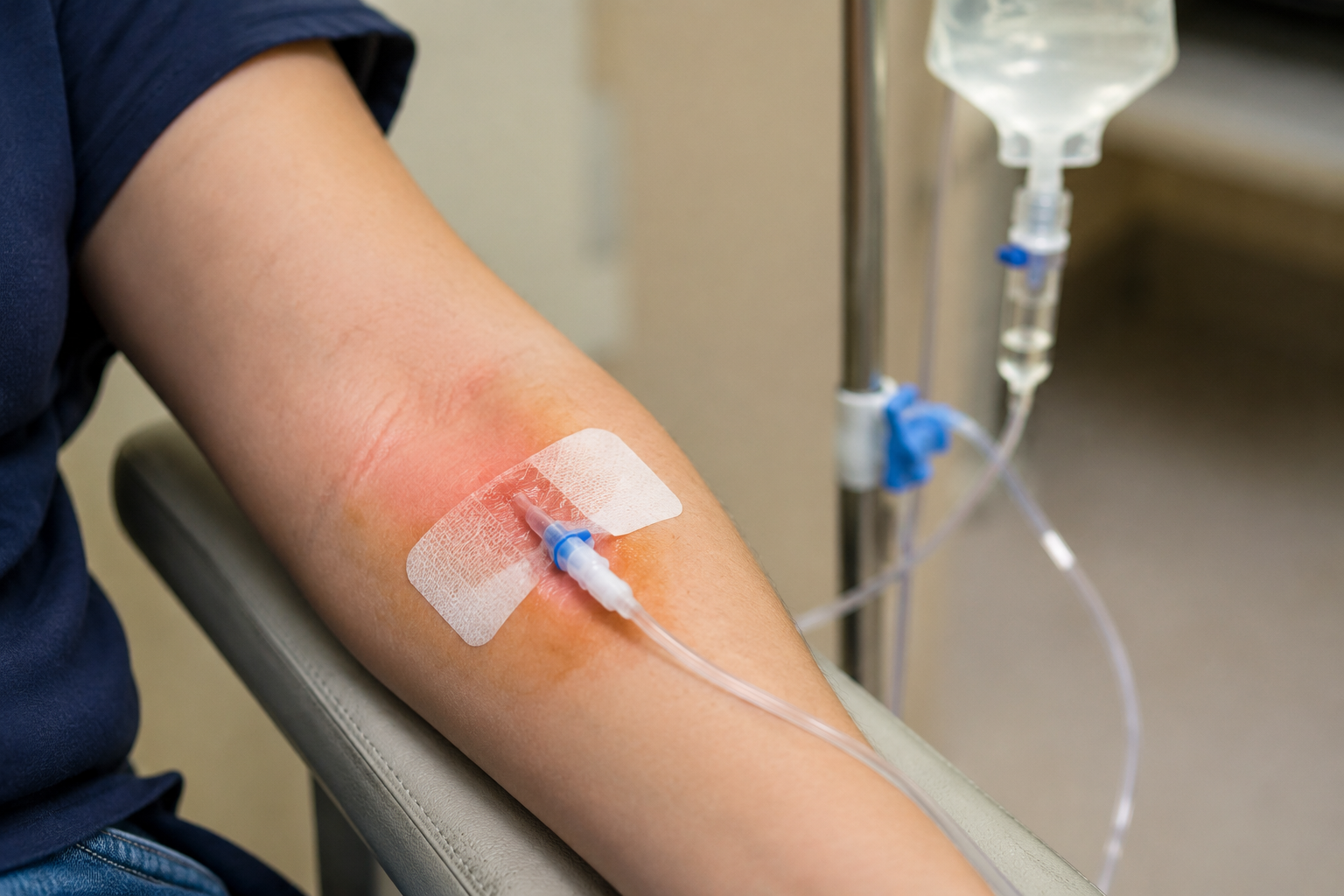
The question of infusion tolerance is a highly practical one for IV hydration providers: why does one patient tolerate an infusion without issue while another reports burning, pressure, warmth, or localized discomfort?
In an IV hydration clinic, providers often focus on the targeted benefits of individual ingredients such as Vitamin C for immune support, magnesium for muscle recovery, glutathione for antioxidant defense, or NAD+ for cellular energy. However, every additive introduced into an IV bag changes more than the intended clinical outcome; it also alters the final osmolarity of the solution.
Understanding which ingredients contribute most significantly to osmolarity directly influences protocol design, fluid volume selection, and administration rates, ultimately improving patient comfort and infusion tolerance.
Why Does the Myers’ Cocktail Cause Vein Irritation or Flushing?
Few IV formulations are more recognizable than the Myers’ Cocktail. Often considered an industry standard for wellness IV therapy, the Myers’ Cocktail typically contains a combination of Vitamin C, magnesium, calcium, B-complex vitamins, and Vitamin B12. While exact formulations vary between medical practices, these ingredients remain the foundational core of the therapy.
From a clinical standpoint, several of these ingredients contribute significantly to the overall osmolarity of the infusion. Magnesium and calcium require careful consideration because both are potent electrolytes with systemic physiologic effects. As concentrations increase, providers may note increased reports of vein sensitivity, local discomfort, flushing sensations, or reduced tolerance to rapid infusion rates.
This does not mean the formulation is inappropriate; rather, it underscores that concentration, proper dilution, and infusion velocity dictate the patient experience.
Why Does NAD+ IV Therapy Require Slow Infusion Rates?
Nicotinamide adenine dinucleotide (NAD+) serves as a primary example of how an additive influences both administration strategy and patient tolerance. Patients frequently question why an NAD+ drip requires two to four hours, while standard hydration protocols take less than an hour. The extended duration is not due to marketing positioning, but rather clinical necessity: NAD+ requires slow administration because patients experience distinct, dose-dependent systemic symptoms during rapid infusion.
These symptoms commonly include chest tightness, abdominal cramping, nausea, upper-body warmth, headache, or generalized physiological discomfort. These reactions are typically not allergic responses; instead, they relate directly to the rate of cellular exposure and the rapid systemic introduction of the coenzyme.
Slowing the infusion rate significantly improves tolerability, making NAD+ an essential case study in how compounding formulation design and delivery speed impact vascular and patient tolerance.
How Does High-Dose Vitamin C Affect IV Osmolarity in Immunity Drips?
Immune-focused protocols remain among the most frequently requested offerings in IV hydration medicine. These formulations commonly utilize high-dose Vitamin C (ascorbic acid), zinc, and glutathione. Of these ingredients, Vitamin C exerts the greatest impact on the osmolarity of the solution, expanding exponentially as the dosage increases.
As clinical protocols evolve, providers must remain mindful of mandatory dilution volumes, minimum infusion durations, and venous tolerance thresholds. The primary objective is not merely delivering a higher concentration of Vitamin C, but administering it within a vehicle that remains isotonic or safely hypertonic to maintain peripheral vein integrity and patient comfort.
What Causes Burning During Athletic Recovery and Amino Acid IV Infusions?
Performance and recovery drips routinely combine magnesium, taurine, L-glutamine, L-arginine, and various amino acid blends. When multiple amino acids are introduced alongside concentrated electrolyte additives, the osmolarity of the solution climbs rapidly.
This cumulative effect explains why two seemingly identical recovery protocols can yield drastically different results regarding patient comfort. Clinical designers must evaluate how these ingredients interact collectively within the final hypertonic solution rather than examining each compound in isolation.
Managing Osmolarity in Glutathione, Beauty, and Wellness Formulations
Beauty-focused infusions frequently leverage a combination of glutathione, biotin, and Vitamin C. While glutathione typically serves as the primary marketing headline for the service, clinical providers must evaluate the total tonicity of the entire formulation.
The final osmolarity of the solution is determined by the cumulative solute load of all additives. A formulation’s peripheral vein tolerability is driven by the entire recipe rather than the single headline ingredient listed on the patient menu.
Evaluating Peripheral Vein Tolerance in Energy and Metabolism Drips
Energy and metabolic protocols commonly incorporate L-carnitine, high-dose Vitamin B12, and lipotropic compounds. Because these formulations vary significantly across clinical practices, providers must assess the final compounded osmolarity rather than relying on standard category nomenclature.
Continuous protocol assessment ensures that additive combinations remain appropriate for peripheral venous access and helps determine whether adjustments to baseline fluid volume or delivery times are required to optimize tolerance.
IV Protocol Optimization: Questions for Medical Directors and Providers
When reviewing clinical protocols with a medical director, clinical staff should systematically evaluate the following criteria:
- Which specific ingredient or solute is contributing most significantly to the final osmolarity?
- Does the cumulative solute concentration of this formulation require additional fluid dilution (e.g., transitioning from 250mL to 500mL of carrier solution)?
- Is the designated infusion rate appropriate for the calculated tonicity of the solution?
- Have patients consistently reported burning, tracking, or localized intolerance with this specific protocol?
- Would expanding the scheduled infusion duration improve the patient experience without compromising clinical efficacy?
These operational and clinical questions have a demonstrably greater impact on patient retention and safety outcomes than the marketing terminology assigned to the protocol.
Clinical Conclusions for IV Providers
Osmolarity is never dictated by a single ingredient; it is the mathematical total of every solute, additive, and buffer placed into the fluid bag. As wellness IV formulations become increasingly customized and highly concentrated, each additional compound fundamentally alters the physiological equation.
The most successful clinical IV protocols successfully balance two distinct objectives: delivering therapeutic levels of active ingredients while strictly maintaining vascular tolerance and patient comfort. In contemporary IV medicine, understanding the precise mechanisms driving osmolarity is just as critical as understanding the therapeutic indication for the formulation itself.