
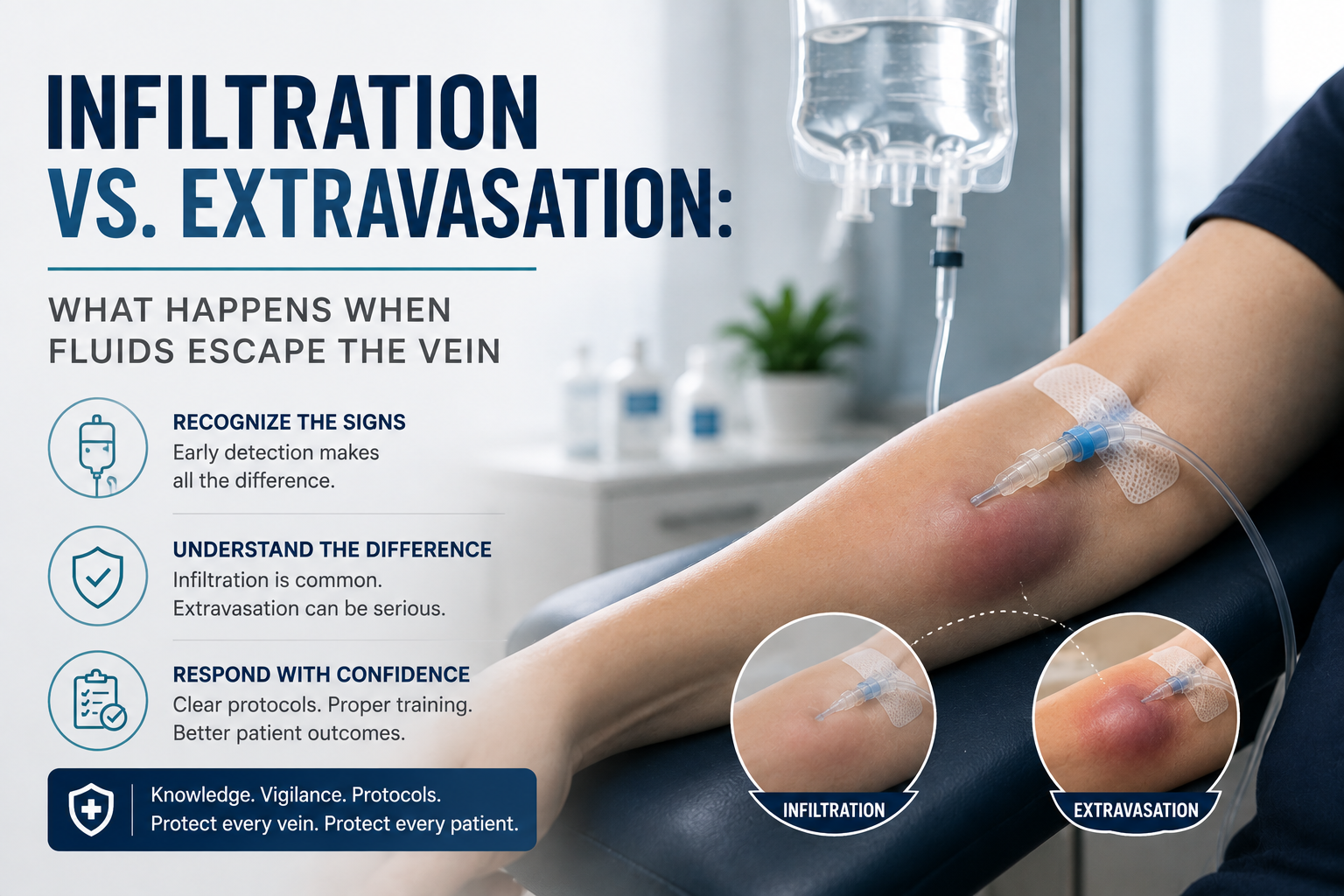
In peripheral IV therapy, achieving a smooth vein entry and getting a flash of blood is only the first step. The real ongoing challenge is ensuring that the solution stays inside the vascular system for the entire duration of the drip. When IV fluid escapes the vein and leaks into the surrounding tissue, providers are dealing with infiltration. While it is one of the most common localized complications in peripheral administration, its clinical severity depends heavily on what is inside the bag and how effectively a clinic’s internal operational policies guide the response.
The Mechanics of Infiltration
Infiltration occurs when a non-vesicant IV solution unintentionally leaks out of the target vein into the surrounding subcutaneous tissue instead of remaining within the vascular channel. This usually happens in one of three ways:
- Puncture or Dislodgement: The catheter tip pierces through the back wall of the vein or slides out of the vessel entirely due to patient movement or inadequate stabilization.
- Endothelial Friction: The catheter wall rubs against and degrades the delicate internal lining of the vein over time, creating a leakage point.
- Venous Pressure: Fluid is infused faster than the vein can clear it, causing backpressure that forces solution out around the insertion site.
The Warning Signs
Because fluid accumulates in tissue rather than flowing through the bloodstream, the physical presentation of infiltration is distinct:
- Localized Edema: Swelling develops around, or distal to, the insertion site.
- Temperature Change: The tissue around the site feels cool to the touch (unlike localized inflammation or infection, which feels warm).
- Skin Changes: The skin may appear pale, blanched, tight, or shiny.
- Flow Disruption: The gravity flow rate slows significantly or stops altogether because the surrounding tissue creates resistance that the fluid cannot easily overcome.
- Sensation: Rather than a sharp, localized burn along the vein channel, patients usually report a feeling of tightness, heaviness, or dull aching pressure at the site.
The Critical Escalation: Extravasation
Infiltration becomes an extravasation when the fluid leaking into the tissue contains a vesicant, a substance capable of causing severe tissue irritation, blistering, or cellular necrosis. In wellness and hydration clinic settings, many additives that are perfectly safe inside a vein become vesicants when trapped in subcutaneous tissue. Highly hypertonic solutions, high-dose potassium, concentrated calcium, or extreme pH formulations can cause severe tissue breakdown and localized necrosis if allowed to pool in tissue.
When an adverse event like infiltration occurs, there is no single, static rulebook that fits every clinical scenario. This is precisely why medical compliance and operational safety are moving targets.
Managing vascular complications effectively requires continuous interaction between the patient, staff, medical directors, and evolving industry benchmarks. A clinic’s response cannot rely on memory or guesswork; it relies on structured, up-to-date internal standard operating procedures (SOPs).
Because wellness formulations vary widely between practices, every facility must maintain its own vetted policy for managing extravasation based on the specific osmolarities, pH levels, and nutrients on its menu. Industry benchmarks, such as those published by the Infusion Nurses Society (INS), are updated regularly as new clinical evidence emerges. A compliant clinic actively reviews and integrates these updates into its standing orders. Compliance is an active daily culture. It involves routine training on standardized tools, objective documentation, and clear escalation pathways when a patient experiences an unexpected reaction. Understanding the physiology of fluid shifts is essential, but having clear, enforced internal policies is what protects both the patient’s health and the practice’s clinical integrity when complications arise.
References & Further Reading
- Infusion Nurses Society (INS) – Infusion Therapy Standards of Practice: The gold-standard guidelines on infiltration grading, risk mitigation, and vascular site management. INS Standards
- National Library of Medicine / StatPearls – Peripheral Intravenous Line Infiltration: Clinical overview of risk factors, assessment, and management of fluid extravasation. NCBI Bookshelf