
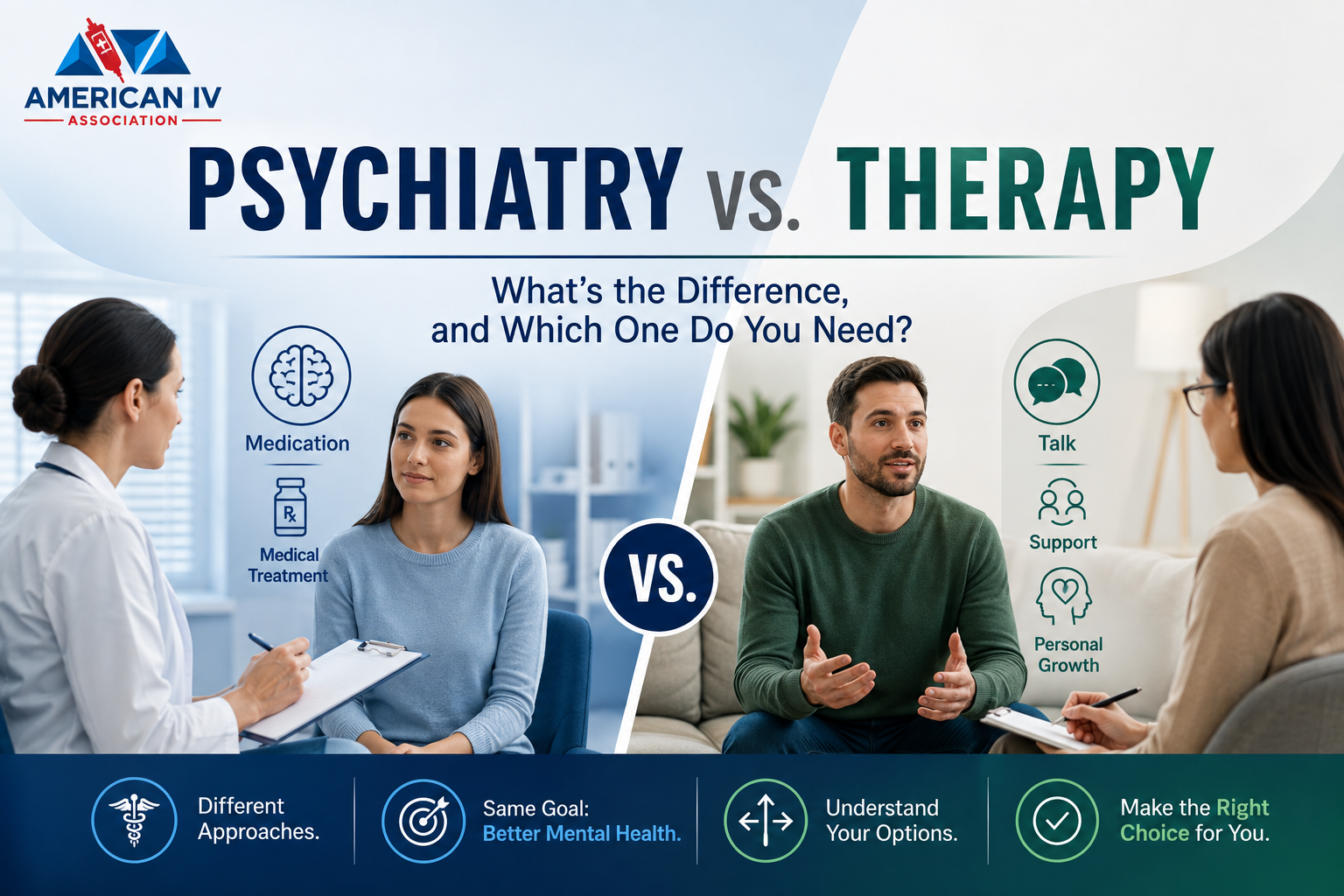
Psychiatry vs therapy — if you’ve ever tried to figure out which one you actually need, you’re not alone. You’ve decided you want mental health support. Good — that’s the hard part. Now you’re staring at two words, “psychiatrist” and “therapist,” that get tossed around almost interchangeably in everyday conversation but mean genuinely different things: one treats through medicine, the other through conversation. Picking wrong doesn’t ruin anything — you can always add the other later — but knowing the difference upfront saves you time, money, and a few confusing phone calls.
The Short Version
Psychiatry is medical treatment for mental illness, usually centered on medication. Therapy is a talk-based process focused on understanding and changing thoughts, feelings, and behavior. Psychiatrists are medical doctors. Most therapists are not — but that doesn’t make them less qualified for what they do.
Psychiatry: The Medical Approach
A psychiatrist has been through medical school and a residency specifically in psychiatry, which means they can:
- Diagnose mental health conditions
- Prescribe and adjust medication
- Order labs or scans when a physical cause needs ruling out
- Treat the neurochemical side of mental illness
- Oversee more intensive interventions — ECT, ketamine treatment, or inpatient care — when needed
In many countries, especially the US, a lot of day-to-day medication management is now handled by psychiatric nurse practitioners (PMHNPs) rather than psychiatrists directly. They can prescribe and diagnose too, usually work under or alongside a psychiatrist, and are often easier to get an appointment with. If you’re told you’re seeing an “NP” instead of a psychiatrist, that’s normal, not a downgrade.
Follow-up psychiatric appointments tend to be short — often 15–20 minutes — and focused on symptoms, medication effects, and side effects rather than deep conversation. The initial evaluation is usually longer.
Psychiatry is typically the first stop for major depression, bipolar disorder, schizophrenia, severe anxiety, ADHD, and OCD, especially when symptoms are disruptive enough that brain chemistry itself needs adjusting.
Think medication might help? A psychiatric evaluation is the only way to know for sure — it’s worth booking one even if you’re just exploring the option.
Therapy: The Talk-Based Approach
Therapists — psychologists, social workers, counselors, marriage and family therapists — can’t prescribe medication, but they’re extensively trained in specific talk-based methods. Titles and required credentials vary by country (in the UK you might see a “counselling psychologist” or “psychotherapist,” in the US an LCSW or LPC, in Australia a “clinical psychologist” with AHPRA registration), so it’s worth checking what’s standard where you live.
A therapy session usually runs 45–60 minutes and covers:
- Patterns in thinking and behavior
- Past experiences shaping present struggles
- Coping strategies for stress, trauma, grief, or relationships
- Skill-building — emotional regulation, communication, boundary-setting
Therapy isn’t one method. CBT, psychodynamic therapy, DBT, EMDR for trauma — different approaches suit different problems, so the type of therapy often matters more than the letters after someone’s name.
Not sure which therapy style fits you? Most directories (like Psychology Today or your national therapist-finder site) let you filter by specialty and approach — a quick search beats guessing.
Key Differences at a Glance
| Psychiatry | Therapy | |
|---|---|---|
| Provider | Psychiatrist (MD/DO) or psychiatric NP | Psychologist, social worker, counselor, etc. |
| Can prescribe medication | Yes | No |
| Session length | Often 15–20 min (follow-ups) | Usually 45–60 min |
| Primary focus | Diagnosis, medication, biology | Thoughts, behaviors, emotional processing |
| Typically used for | Moderate-to-severe or complex conditions | Ongoing support, coping skills, processing |
The Cost Question Nobody Talks About Enough
Honestly, cost is often what actually decides this for people — more than symptoms do.
- Insurance coverage varies a lot. In the US, psychiatric visits (especially with an MD) are often billed as specialist medical care, while therapy costs vary wildly by provider type and network. In countries with public healthcare (UK’s NHS, Canada, much of Europe/Australia), psychiatric care is often free or low-cost through the public system, but wait times can be long — private options exist but cost more.
- Therapy is often the pricier ongoing expense simply because sessions are weekly or biweekly, while psychiatric follow-ups might be monthly or less once you’re stable on a medication.
- Sliding-scale therapy (fees adjusted to income) is common and worth asking about directly — many therapists offer it even if it’s not advertised.
- If cost is a real barrier, community mental health centers, university training clinics, and employee assistance programs (EAPs) are worth checking before ruling either option out.
Not sure what your plan covers? Call the number on the back of your insurance card and ask specifically about mental health / behavioral health benefits — it takes five minutes and can save you a lot of guessing later.
Do You Need One, or Both?
Plenty of people do best with both — a psychiatrist or NP managing medication while a therapist works through the thought patterns or life circumstances feeding the symptoms. Research generally supports medication plus therapy outperforming either alone for moderate-to-severe depression and anxiety.
But not everyone needs both. If what you’re dealing with is situational — a breakup, work burnout, a rough transition — therapy alone is often enough. If symptoms are severe, there’s a family history of mental illness, or therapy alone hasn’t moved the needle, a psychiatric evaluation is worth adding.
How to Actually Start
If you’re unsure where to begin, start with a primary care doctor or a therapist — either can assess what you’re dealing with and refer you onward if medication looks worth exploring. You don’t need to diagnose yourself first. That’s their job.
Ready to take the first step? Here’s a simple starting checklist:
- Call your primary care doctor and ask for a referral, or search a therapist directory directly
- Check your insurance’s mental health benefits (or your local public healthcare options)
- Book the first available appointment — you can always switch providers later if it’s not a fit
The Bottom Line
Psychiatry and therapy aren’t rivals — they’re different tools for different layers of the same problem. Psychiatry treats the biology through medical training and medication. Therapy treats the psychology through structured conversation and skill-building. Knowing which is which means you spend your first appointment getting help, not figuring out if you booked the right kind of help.
Found this useful? Share it with someone who’s trying to figure out where to start — and if you’ve been putting off making that first call, let this be the nudge to make it today.
Work in wellness or IV hydration therapy? Join the American IV Association for training, certification, compliance support, and a network of like-minded professionals. Become a Member today.