
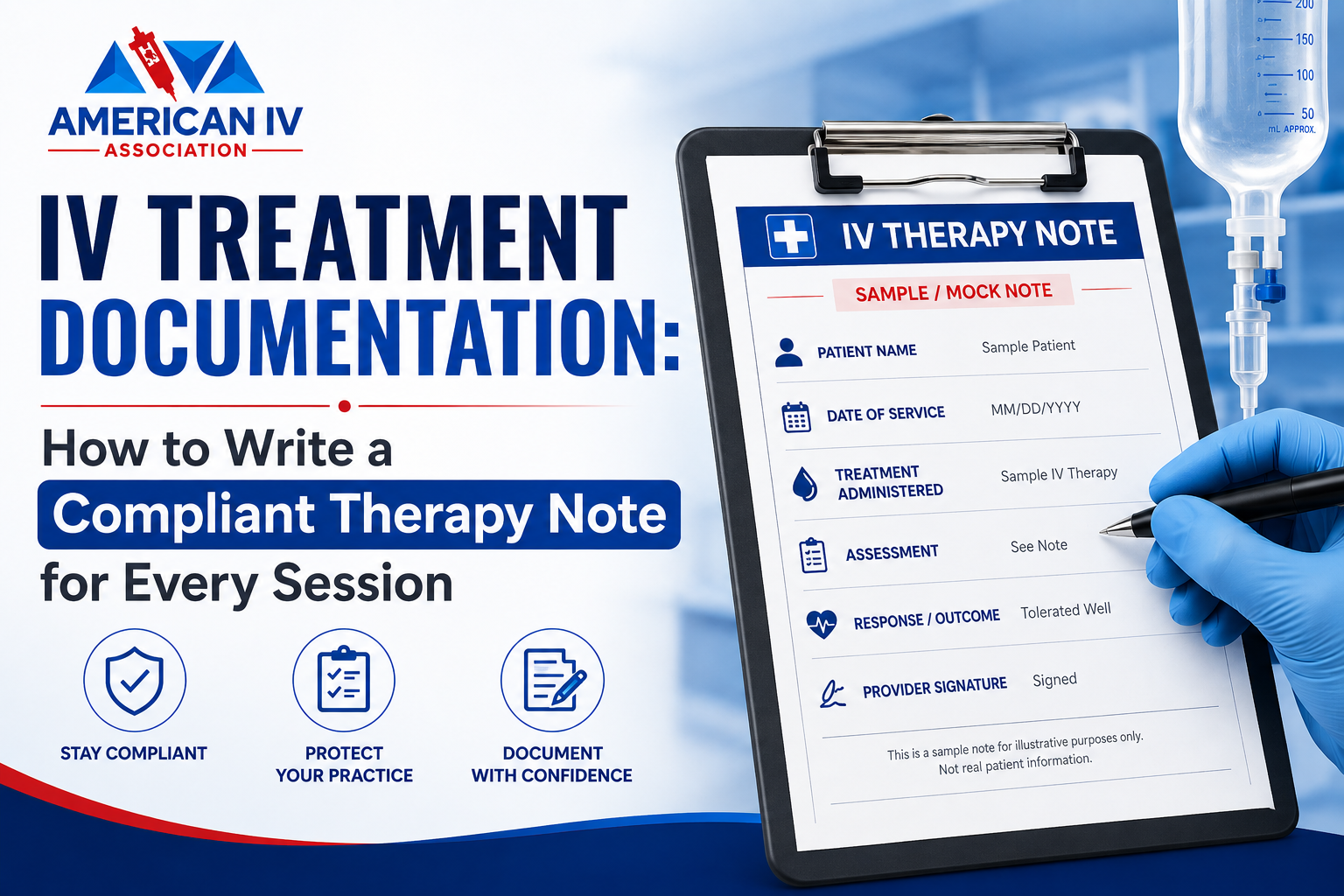
A well-written therapy note is one of the most overlooked safety and compliance tools in IV hydration practice. It’s easy to treat documentation as an administrative afterthought — something to finish quickly between patients, or fill out from memory at the end of a long shift. But a strong treatment record protects your patients, protects your license, and protects your business if a treatment is ever questioned.
As IV hydration therapy has expanded beyond hospital settings into wellness clinics, med spas, and mobile services, documentation standards haven’t always kept pace with the growth. Many providers entered this field from nursing or paramedicine backgrounds where charting was built into an EMR system with structured fields and mandatory prompts. In an independent wellness setting, that scaffolding often doesn’t exist — which means the responsibility for thorough, consistent documentation falls entirely on the individual provider and clinic.
Here’s what belongs in every compliant IV treatment record, why the habit of writing them well matters more than most providers realize, and how to build documentation into your practice without adding administrative burden to your day.
What an IV Therapy Note Actually Is
A therapy note — also called a treatment note or clinical encounter note — is the record created for each patient session, documenting what was assessed, what was administered, how the patient responded, and any follow-up instructions given. In IV hydration therapy, this note is your evidence that screening happened, informed consent was obtained, the correct formulation was given, and the patient was monitored appropriately throughout treatment.
If a complication occurs, or a patient later disputes what took place, this note is often the only objective record of the visit. Incomplete or vague documentation leaves both the patient and the provider exposed — and in a regulatory review, absence of documentation is frequently treated the same as absence of care, regardless of what actually happened in the room.
“If it isn’t written down, it didn’t happen.” It’s a cliché in clinical practice for a reason — in any audit, dispute, or regulatory review, your therapy note is the record that speaks for you when you’re not in the room to explain yourself.
Core Components of a Compliant Therapy Note
1. Patient identification and date/time Full name, date of birth, and the exact date and time of the session — including start and end time of the infusion, not just the appointment time. Missing or vague timestamps are one of the most common documentation gaps found in audits, and they undermine the credibility of everything else in the note.
2. Pre-treatment assessment A summary of the health history review, baseline vital signs, and contraindication screening performed before treatment. For the full protocol on what this step should cover, see our patient screening guide. Your note should explicitly reference that informed consent was discussed and obtained — not just note that a form was signed, since a signature alone doesn’t establish that the conversation actually happened.
3. Formulation and administration details The specific IV formulation given, including every ingredient and dosage, the access site used, needle gauge, and the infusion rate. Any deviation from your standard protocol — a modified formulation, a slower infusion rate, a different access site than usual — should be noted along with the clinical reasoning behind it.
4. Patient response during treatment Notes on how the patient tolerated the infusion — any changes in vital signs, reported symptoms, or adverse reactions, and exactly how they were addressed. Even a routine, uneventful infusion should be documented as such, with vitals if they were rechecked; “no issues” without supporting detail is not a clinical record.
5. Post-treatment status and instructions Condition of the patient at discharge, any instructions given regarding hydration, activity restrictions, or follow-up, and the contact information provided in case concerns arise after the patient leaves your facility.
6. Provider signature and credentials Every note should be signed and credentialed by the clinician who performed or supervised the treatment, with a co-signature process in place where required by your state’s scope-of-practice regulations for the credential level involved.
Not sure your current charting process would hold up under review?
AIVA members get access to ready-to-use documentation templates, sample charting language, and one-on-one compliance consultations to help you close gaps before they become liabilities.
Common Documentation Mistakes
Even experienced, well-intentioned providers fall into predictable documentation habits that weaken their charting over time. Watch for these patterns in your own practice or across your team:
- Copy-paste notes. Reusing identical language across patients — or across visits for the same patient — is a red flag in any audit and suggests assessments weren’t individualized to that specific encounter.
- Vague language. Notes like “patient tolerated well” without accompanying vital signs or specifics don’t hold up if a complication is reported days or weeks later, when memory of the specific visit has faded.
- Delayed documentation. Notes written hours — or days — after the visit are far more prone to error, omission, and unintentional embellishment than records completed at the point of care.
- Missing consent language. Consent should be referenced directly in the clinical note itself, not simply assumed because a signed form exists in a separate file.
- Inconsistent formatting across staff. When each clinician documents differently, it becomes difficult to audit your own charts for quality, and harder to train new staff on what “good” looks like.
Why This Matters for Your Practice
Beyond the obvious legal protection, consistent, high-quality treatment notes deliver value well beyond risk management:
- Create a defensible record in the event of a regulatory review, insurance inquiry, or malpractice claim — often the deciding factor in how quickly and favorably such matters resolve.
- Support continuity of care if a patient sees a different provider on a return visit, ensuring formulation history and any prior reactions are known before the next infusion.
- Strengthen your practice’s credibility with insurers, landlords, and business partners who may request documentation samples during due diligence.
- Make internal quality reviews and staff training far more effective, since you can only coach to a standard that’s clearly defined and consistently followed.
This is especially relevant as regulatory attention on IV hydration therapy continues to increase alongside the field’s rapid growth. Documentation quality is frequently the first thing reviewed when a complaint or complication triggers an investigation — and it’s often the difference between a routine inquiry and a serious finding.
Building a Standard for Your Team
The most reliable way to raise documentation quality across a clinic is to standardize it rather than leave it to individual judgment. In practice, that means:
- A templated therapy note with required fields for screening, formulation, patient response, and discharge instructions — making it structurally difficult to skip a step, even during a busy day with back-to-back patients.
- Clear escalation language built into the template for when something outside the routine occurs, so providers document deviations consistently rather than in an ad hoc way.
- Regular, informal chart audits — even spot-checking a handful of notes monthly helps catch drift before it becomes an entrenched habit across your team.
- New hire onboarding that includes documentation training, not just infusion technique, so charting standards are set from day one rather than picked up informally from whoever trains them.
The Bottom Line
A therapy note isn’t paperwork — it’s the record that proves your practice provides safe, individualized, well-monitored care, session after session. As IV hydration therapy continues to draw regulatory scrutiny and public attention, the providers best positioned to demonstrate their standard of care will be the ones who treated documentation as a clinical priority all along, not an afterthought.
Whether you’re refining an existing charting process or building one from scratch, the investment pays off well before you ever need to prove it did.
AIVA members get access to documentation templates, compliance guidance, and expert consultations through our Compliance Corner.