
Most IV hydration business owners don’t fail an inspection because they’re careless. They fail because compliance was handled in a rush eight months ago, a form got copied from a different state’s template, or the person who “used to handle that” left the business six months back. An inspector doesn’t care why the gap exists — only that it does.
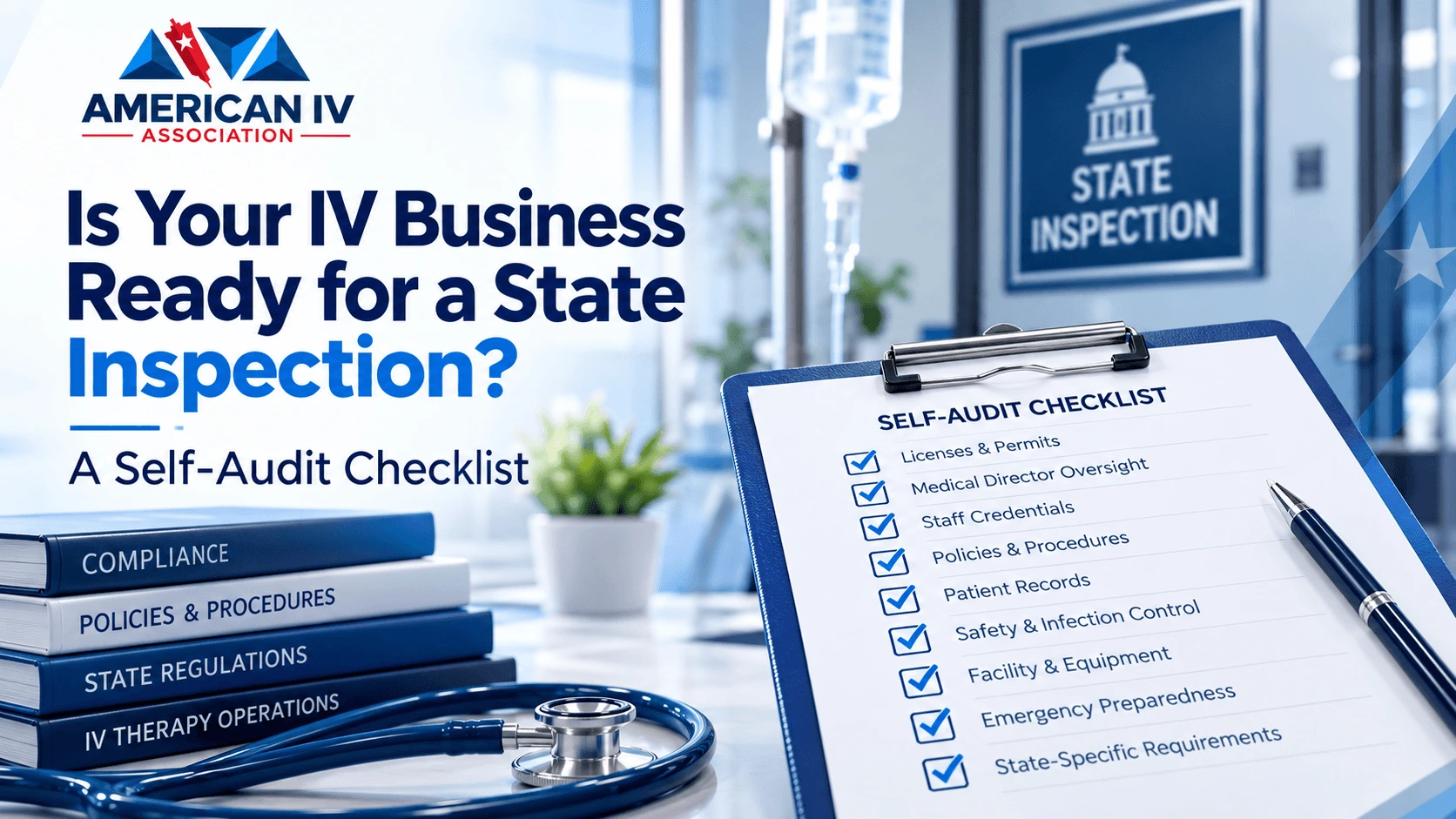
You don’t need to wait for a surprise visit to find out where you stand. Run this self-audit against your own business today, section by section, the way an inspector actually would.
Skip the Guesswork — Sign Up for AIVA Membership →
1. Patient Records & Consent
- Every active patient file has a signed, current consent form on file. Not a verbal agreement, not an emailed “yes” — a signed document specific to the treatment provided, stored where you can retrieve it in under five minutes.
- Photo and testimonial releases exist for every patient image used in marketing. If a patient’s before/after photo is on your Instagram, you need a matching Authorization to Release and Disclose Photographs on file — not a memory of them saying it was fine.
- PHI disclosure authorizations are documented wherever health information leaves your practice. Referrals to a physician, insurance conversations, or sharing labs with a partner clinic all require a signed Authorization for Release of PHI.
2. Biomedical Waste & Sharps Handling
- A written Biomedical Waste Operating Plan exists and matches what your team actually does. Inspectors check the Biomedical Waste Operating Plan against practice, not just against paper. If your plan says one disposal vendor and your team uses another, that’s a red flag even if disposal itself is compliant.
- Sharps containers, storage, and pickup logs are current and accessible on request. Gaps in pickup logs are one of the fastest ways a routine check turns into a formal citation.
3. Emergency Preparedness
- Written Emergency Protocols cover adverse reactions, infiltration, and equipment failure. “We’d just call 911” is not a protocol. Inspectors and your malpractice carrier both expect a documented, trained-on response — see the ready-to-use Emergency Protocols template for the most common IV complications.
- A Disaster Risk Management plan covers power loss, severe weather, and business interruption. Especially critical for mobile providers — the Disaster Risk Management Checklist covers what happens to a patient mid-infusion if a vehicle breaks down or a location loses power.
- Staff can describe the emergency protocol without looking it up. A plan that only lives in a binder no one has opened since onboarding will not hold up under questioning.
4. Staffing & Clinical Oversight
- A current, signed Collaboration Agreement is on file if your model requires physician oversight. This is one of the most commonly missing documents in growing IV businesses. Use a Collaboration Agreement template — verbal understanding is not a substitute.
- Every clinician’s license and credentials are verified and stored, not just “checked once at hiring.” Licenses lapse. A quarterly re-verification catches this before an inspector does.
- An Employee Handbook documents clinical protocols, conduct standards, and HIPAA expectations. This is what turns “our policy” into something enforceable and demonstrable. Start from the Employee Handbook template rather than a blank page.
5. Client-Facing Policies
- A written Cancel and No Show Policy is provided to patients at booking, not improvised after the fact. Beyond protecting revenue, the Cancel and No Show Policy shows an inspector — or a disgruntled patient’s attorney — that your business runs on process, not guesswork.
Found gaps? You’re not alone — and you don’t have to fix them from scratch.
Every form referenced in this checklist is ready to customize in AIVA’s forms library. Members get the full library included; non-members can purchase any individual form for $195.
What to Do With This Checklist
Walk through it today with whoever runs operations, and be honest about every unchecked box — an inspector will be. For each gap, decide whether you’re building the document from scratch, hiring an attorney to draft it, or using a template built specifically for IV hydration practices. The third option is faster and far less expensive than the first two, and it’s the one most AIVA members choose.
Set a recurring date — the first of every quarter works well — to run this same self-audit again. Compliance isn’t a one-time project you finish; it’s a habit the strongest IV businesses build into how they operate.
Stop rebuilding compliance documents one at a time
AIVA membership includes the entire forms library used in this checklist, plus a weekly live Q&A where our attorneys answer compliance questions specific to your business — so the next inspection (or surprise question from a patient’s lawyer) finds a business that’s actually ready.