
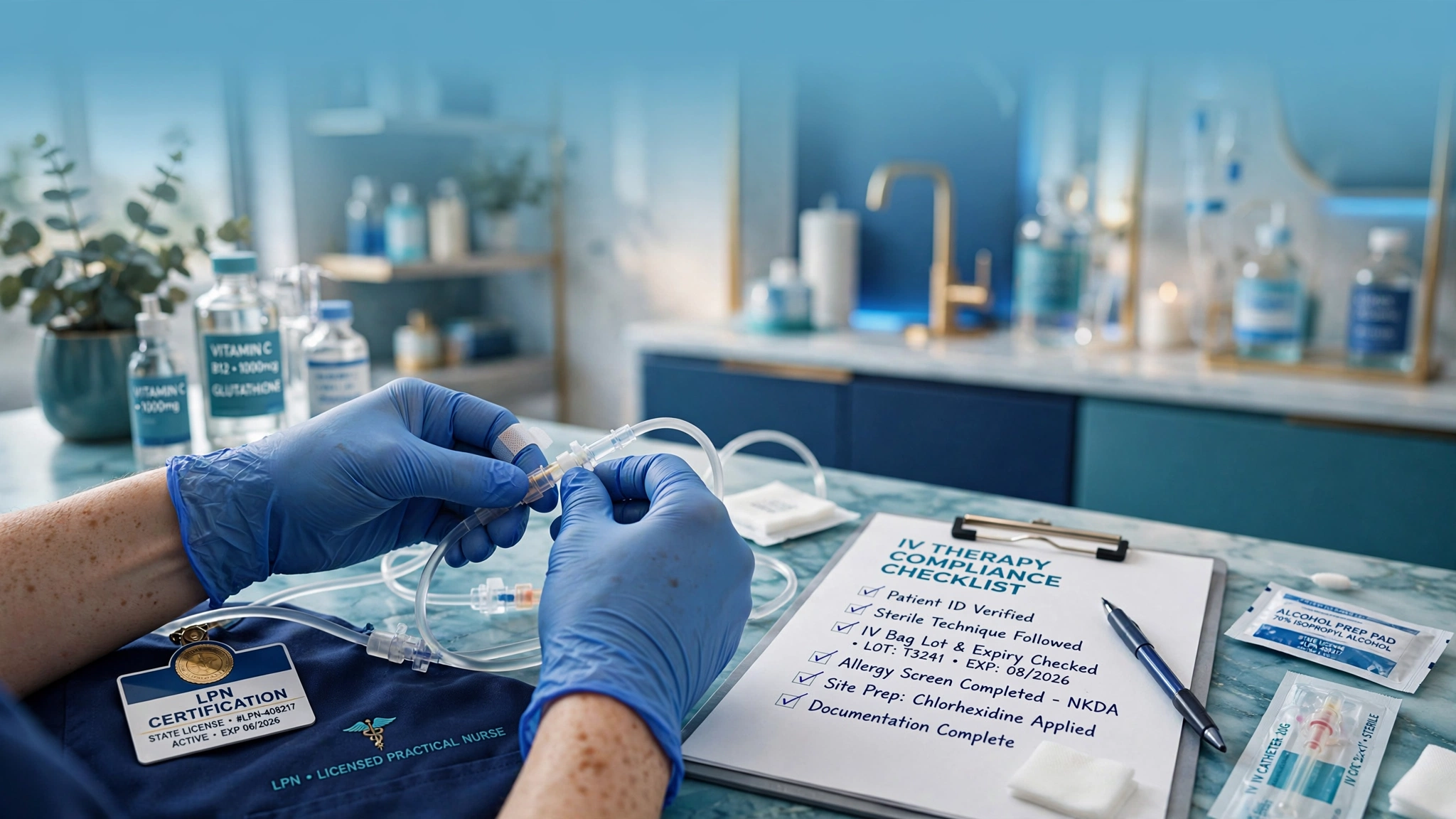
If you’re building or staffing an IV hydration practice, you’ve probably run into this question fast: can an LPN actually start and administer IVs, or do you need an RN for that? The honest answer is the same one that comes up with almost every staffing and compliance question in this industry — it depends on your state, and getting it wrong puts your business, not just your employee, at risk.
If you’ve already read our guide on collaboration agreements and state-by-state supervision requirements, this post picks up the same thread from the staffing side: once you know who’s supervising your clinical care, the next question is exactly what your LPNs are legally allowed to do under that supervision.
Here’s what “IV certification for LPNs” actually means, why it varies so much, what it looks like across different states, and what it means for how you hire, train, and document your team.
“IV Certification” Is a Bit of a Misnomer
In most states, there’s no single national credential called “LPN IV Certification” that an LPN earns once and carries everywhere. Instead, it’s really a combination of three things working together:
- Scope of practice — what your state’s Nurse Practice Act legally permits an LPN to do with IV therapy, if anything, without additional training.
- Additional education — many state boards require LPNs to complete IV-specific coursework beyond their original licensing education before they can legally perform IV therapy at all.
- Facility/employer policy — in many states, what an LPN is allowed to do is also shaped by your practice’s own written policies, supervision structure, and documented competency sign-off — not just the state rule.
That third point is the one business owners miss most often: even where your state permits IV-certified LPNs to perform certain tasks, your business still needs the internal documentation — job descriptions, supervision protocols, competency verification — to make that permission actually hold up under audit or inspection. This is exactly what AIVA’s Employee Handbook template is built to cover for IV hydration and infusion practices.
What LPN IV Certification Typically Covers (and Doesn’t)
Where state boards do require additional training, programs generally follow a predictable pattern: a set number of contact hours covering infusion therapy legalities, peripheral IV insertion and management, complication recognition, and documentation standards, followed by a skills competency check-off — often requiring supervised IV starts witnessed and signed off by an RN before the LPN can practice independently.
Even after completing that training, most states draw a hard line around certain high-risk categories. IV push or bolus medications, blood and blood product administration, chemotherapy, and investigational drugs are commonly excluded from LPN scope entirely, regardless of additional certification — meaning no amount of extra training unlocks those tasks for an LPN in most states.
How Requirements Differ by State
This is a general orientation based on publicly available board guidance — not a legal determination for your business — but it illustrates why one state’s approach can’t simply be copied into another.
| State | General Approach | What This Means for Hiring |
|---|---|---|
| Florida | IV-certified LPNs may perform defined IV therapy tasks under RN or physician supervision, with specific tasks (blood products, chemotherapy, investigational drugs) carved out by rule even for certified LPNs. | You can build an LPN-involved IV program, but your job descriptions and supervision documentation need to mirror the state’s exact carve-outs. |
| New York | LPNs must complete IV Therapy Training regardless of setting, with a detailed state-issued chart separating in-scope tasks from those requiring clinical judgment LPNs cannot exercise at any experience level. | Training completion alone isn’t enough — your internal task assignments need to match the state’s task-by-task breakdown. |
| Mississippi | Requires documented completion of a board-approved IV therapy course; transcripts must be audit-accessible. IV push/bolus medications are prohibited for LPNs. | Keep signed training records on file, not just verbal confirmation — this is exactly what an auditor will ask for first. |
| Oklahoma | The Board of Nursing does not approve specific IV certification courses; scope is instead defined through RN delegation and facility policy. | Your facility policy is the compliance document here — a written delegation and supervision policy is essential, not optional. |
| Arizona | Guidance is issued through Board Advisory Opinions rather than formal certification, with recommended course content and competency-verification expectations. | “IV certified” in Arizona typically means completion of a specific recommended course package — confirm your training provider aligns with current board guidance. |
The pattern across every state is the same even though the specifics differ: training plus documentation plus supervision, in combinations unique to each jurisdiction. A business owner who assumes “LPN IV certified” means the same scope everywhere is working from a false sense of security — the same false sense of security that trips people up on collaboration agreement requirements.
State requirements are subject to change — always confirm current rules directly with your state board of nursing before finalizing hiring or training decisions.
What This Means for Your IV Business
If you’re hiring or currently employing LPNs to perform any IV-related tasks, there are a few things worth confirming now rather than during an inspection or after an incident:
- Does your state require LPNs to complete additional IV training before performing IV therapy, and has each LPN on staff actually completed it — with documentation on file, not just a verbal confirmation?
- Is your supervision structure documented — who is the supervising RN or physician, how is oversight provided, and is that spelled out in writing rather than assumed?
- Does your job description and employee handbook reflect what your state actually allows, including the specific tasks that remain out of scope even for IV-certified LPNs?
- Do you have a competency verification and sign-off process on file for each LPN performing IV therapy, in case a state board or inspector asks for it?
Business owners who get this wrong tend to find out at the worst possible moment — a complication, a complaint, or a routine inspection — rather than catching it proactively. And because this overlaps so heavily with collaboration and supervision agreements, it’s rarely a standalone issue; it’s usually one piece of a broader documentation gap. AIVA members get access to weekly attorney-led Compliance Corner Q&As, where questions like these get answered live for your specific state.
Frequently Asked Questions
Can an LPN start and administer IVs on their own?
In most states, not without additional IV-specific training beyond basic LPN licensure, and typically only under RN or physician supervision. The specific tasks allowed vary significantly by state.
Is LPN IV certification a one-time credential?
Not usually. Many states or employer policies require periodic renewal, and even where training doesn’t expire, your business still needs to maintain current, audit-ready documentation of each LPN’s competency.
Can an IV-certified LPN perform IV push medications?
In most states, no — IV push/bolus medications are commonly excluded from LPN scope entirely, regardless of additional IV certification.
Does LPN IV certification transfer between states?
Generally no. Training completed under one state’s requirements often doesn’t automatically satisfy another state’s rules, which is a common and costly mistake for businesses expanding into new states.
Who is responsible if an LPN performs IV therapy outside their legal scope?
Both the individual LPN and the business can face consequences — license complaints for the clinician, and regulatory, insurance, or liability exposure for the practice owner, especially if supervision and documentation weren’t properly in place.
Building This Into Your Practice the Right Way
Because requirements differ by state, by task, and by your specific staffing model, the safest approach is:
- Confirm your state board’s current LPN IV therapy rules directly, rather than relying on what another business or a general nursing forum says.
- Verify and document each LPN’s IV training and competency before they perform any IV therapy, and keep that documentation audit-ready.
- Put your supervision structure and scope limitations in writing — in your employee handbook, job descriptions, and standing order or collaboration documentation.
- Revisit this whenever your state’s rules change, you expand into a new state, or your staffing mix changes.
Document your team’s scope and supervision the right way — before an inspection forces the issue.
AIVA members get instant access to the Employee Handbook, Employment Contracts Checklist, and Collaboration Agreement — ready-to-use templates built specifically for IV hydration and infusion practices — so your staffing structure is audit-ready from day one.
Prefer to browse individual templates first? Visit the Education & Resources page → to see all available forms, certification programs, and standards books.