
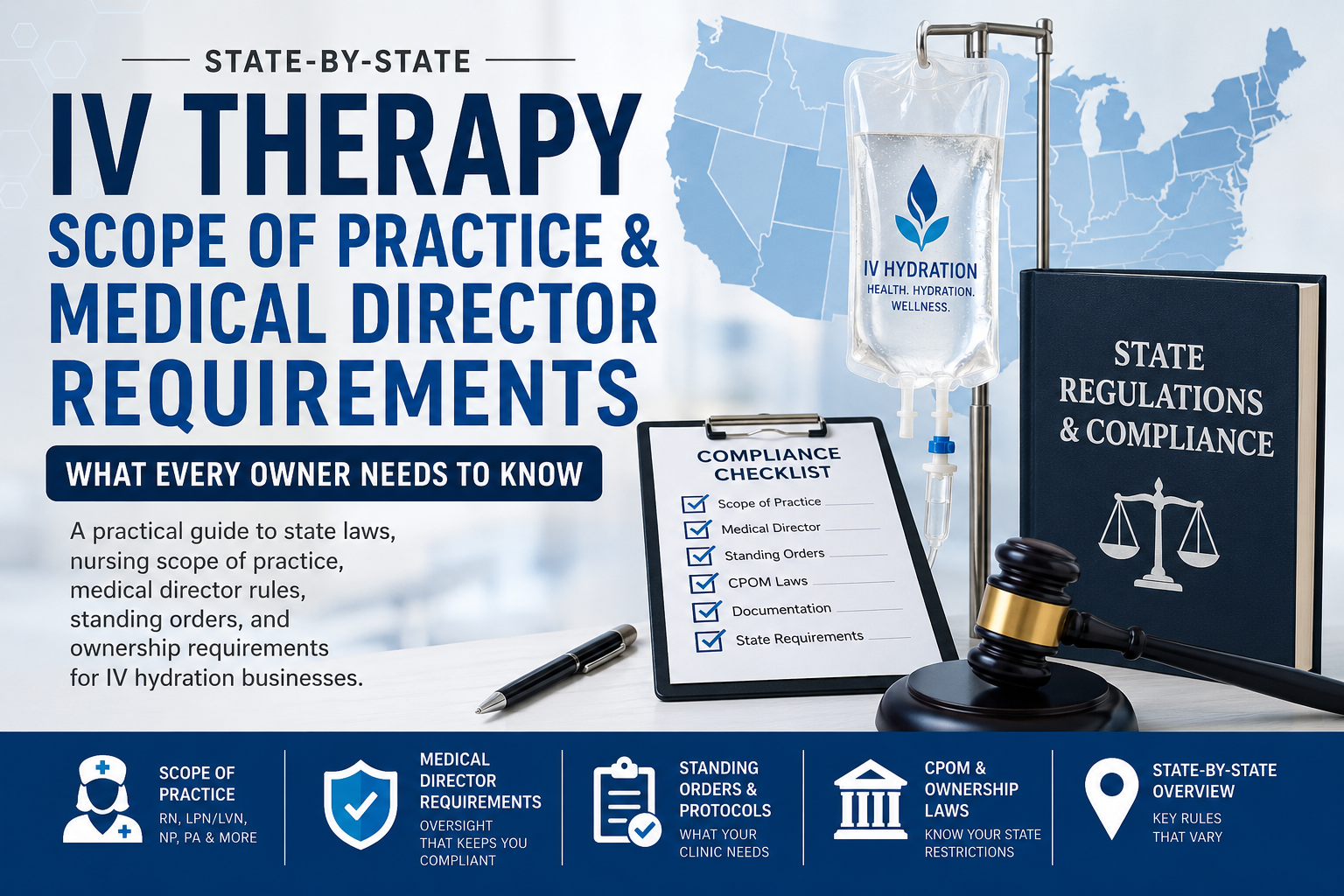
If you’ve spent any time researching how to legally open or run an IV hydration business, you already know the frustrating truth: there is no single federal rulebook. IV therapy scope of practice by state sits at the intersection of nursing regulations, medical board oversight, and corporate practice of medicine (CPOM) law — and all three are set at the state level. What’s routine in Florida can trigger a board investigation in New York.
This guide won’t replace a conversation with a healthcare attorney licensed in your state (nothing should). What it will do is give you the framework regulators actually use, so you know exactly what questions to ask before you sign a lease, hire a nurse, or bring on a medical director.
Why IV Therapy Is Regulated So Tightly
IV therapy involves piercing the skin and infusing fluids, vitamins, and sometimes medications directly into the bloodstream. Because it’s an invasive procedure, it falls under the practice of medicine in all 50 states — not a wellness or cosmetic service. That single classification is what triggers everything else: who can own the business, who can order the drip, who can insert the needle, and who has to sign off on it.
Three separate — but overlapping — regulatory layers govern your clinic:
- Corporate Practice of Medicine (CPOM) laws — determine who can own a business that delivers medical services.
- Nursing scope of practice rules — determine what an RN, LPN/LVN, or NP can legally do without direct physician involvement.
- Medical director / standing order requirements — determine what oversight structure has to exist before a single drip is administered.
Layer 1: Who Can Own the Business (CPOM States)
Many states enforce corporate practice of medicine laws that block non-physicians and outside investors from owning a business that delivers medical care. Because IV therapy is classified as a medical service in most jurisdictions, this affects nearly every IV clinic, mobile IV company, or med spa that offers infusions.
- Strict CPOM states (California, New York, Illinois, and others) generally require majority physician ownership of the clinical entity, or a Management Services Organization (MSO) structure — where a business owner runs operations, marketing, and non-clinical functions, while a physician-owned professional entity holds the clinical license and contracts back for services.
- More flexible states (Florida, Nevada, and others) don’t enforce ownership percentage requirements as strictly, allowing non-physicians to own the business outright as long as a licensed medical director provides clinical oversight.
The takeaway: before you draft an operating agreement, confirm whether your state requires physician ownership, permits an MSO model, or allows non-physician ownership outright. Getting the entity structure wrong is one of the most common — and expensive — mistakes new owners make.
Layer 2: Who Can Actually Administer the IV
Even once ownership is settled, you still need to know who’s allowed to touch the needle. This is governed by each state’s board of nursing (or, for paramedics, the state EMS authority) — and it varies by license type.
Registered Nurses (RNs): IV cannulation is part of the RN scope of practice nationwide, so no state requires additional certification just to start a peripheral IV. However, RNs generally cannot independently order treatment, prescribe, or open a supplier account — they administer under a physician- or NP-signed standing order.
LPNs/LVNs: This is where the rules concentrate the most variation. Some states grant LPNs IV authorization automatically after an approved nursing program; others require a separate board-approved IV certification course before an LPN can perform infusion therapy at all, and most restrict LPNs from advanced procedures like IV push medications or blood products.
Nurse Practitioners (NPs) and Physician Assistants (PAs): In full-practice-authority (FPA) states, NPs can prescribe and even serve as the supervising provider independently. In restricted-practice states, NPs need a collaborating physician, and PAs typically need a supervision or collaboration agreement regardless of state.
Medical assistants and non-licensed staff: Cannot legally start an IV or administer an infusion in any state, regardless of internal training.
Paramedics/AEMTs: Regulated separately through each state’s EMS authority rather than the board of nursing — relevant mainly for mobile IV operators recruiting from an EMS background.
Layer 3: When You Need a Medical Director
Because IV therapy requires a valid order, virtually every state requires some form of physician (or, in FPA states, independent NP) oversight before treatment begins. In practice, that means:
- A medical director — typically a licensed MD or DO — writes and signs the standing orders and treatment protocols your clinic operates under.
- A valid provider-patient relationship must generally be established (via in-person exam, telehealth visit, or standardized intake protocol) before a client receives an infusion — some states are strict about what qualifies as a legitimate assessment.
- The medical director is expected to stay actively engaged, not just “on the letterhead” — through periodic chart review, availability for consults, and oversight of adverse events.
- Medical director involvement doesn’t usually require them to be on-site. Most states allow remote oversight, provided protocols are signed, updated, and the physician is reasonably available.
Medical director fees for IV therapy businesses commonly range from a few hundred to a few thousand dollars per month, depending on the number of locations, chart review volume, and drip menu complexity.
A Snapshot: How the Same Question Gets Different Answers
| State | Ownership Model | Who Can Administer | Oversight Note |
|---|---|---|---|
| California | Strict CPOM — physician ownership or MSO required | RNs administer independently under standing orders; LVNs need additional IV certification and RN/physician availability | Chart review expectations are common practice |
| Florida | Non-physician ownership generally allowed | RNs must complete a state-recognized IV certification course | Every IV hydration business still needs a physician medical director |
| Texas | Physician, NP, or PA must order treatment | RNs administer under delegation; unlicensed staff cannot | Recent legislation tightened who can order elective IV therapy |
| Nevada | More flexible ownership | RNs and APRNs administer under supervisory/delegation agreements | Written scope-of-practice matrix expected for clinical staff |
| Washington | Standard oversight model | RNs and LPNs administer under an authorized provider’s direction | Standing orders must be current and specific |
This table is illustrative, not exhaustive — regulations are amended frequently, and “who can do what” can shift with a single piece of legislation (as happened in Texas in 2025). Always verify current requirements directly with your state board of nursing, board of medicine, and a healthcare attorney before relying on any summary, including this one.
A Practical Verification Checklist Before You Launch or Expand
- Confirm your state’s CPOM stance. Does the clinical entity need majority physician ownership, or is an MSO structure required/available?
- Identify your state’s NP practice authority level. This determines whether an NP can serve as your sole supervising provider or whether you need a collaborating physician.
- Map your staffing model to scope of practice. Confirm what your RNs, LPNs, or paramedics are actually authorized to do — cannulation, IV push, central line access, etc. — under your specific state’s rules.
- Secure a medical director and documented standing orders before you administer a single infusion, not after your first client books.
- Build in ongoing chart review and QA processes. Many states expect (or require) documented oversight, not a one-time signature.
- Re-verify annually. State boards update advisory opinions and scope rules without major public announcements — what was compliant last year may not be this year.
Become an AIVA Member today and gain access to the tools, education, and expert guidance designed specifically for IV hydration business owners.
👉 Join today and grow your IV therapy business with confidence.
The Bottom Line
There’s no shortcut around state-specific research, but there is a pattern to how these rules are built: ownership rules protect who controls the medical decision-making, scope-of-practice rules protect what each license holder is qualified to do, and medical director requirements protect the patient once treatment begins. Once you understand those three layers, “what does my state require” becomes a much more answerable question.
If you’d rather not track fifty sets of evolving regulations on your own, that’s exactly the gap AIVA’s Compliance Corner is built to close — members get access to attorney-led Q&A sessions and up-to-date, state-specific regulatory guidance, so you can make ownership, staffing, and medical director decisions with confidence instead of guesswork.
Get Compliance Support Built for IV Therapy Owners
Navigating scope of practice and medical director requirements shouldn’t fall entirely on you. AIVA membership gives you:
- Direct access to attorney-led Compliance Corner Q&A sessions, held weekly
- Up-to-date, state-specific regulatory summaries — no more piecing it together from outdated blog posts
- A vetted network of medical directors, vendors, and industry partners
- Ongoing education to keep your business compliant as laws change
Join AIVA today and get the compliance support your business needs to grow with confidence.