
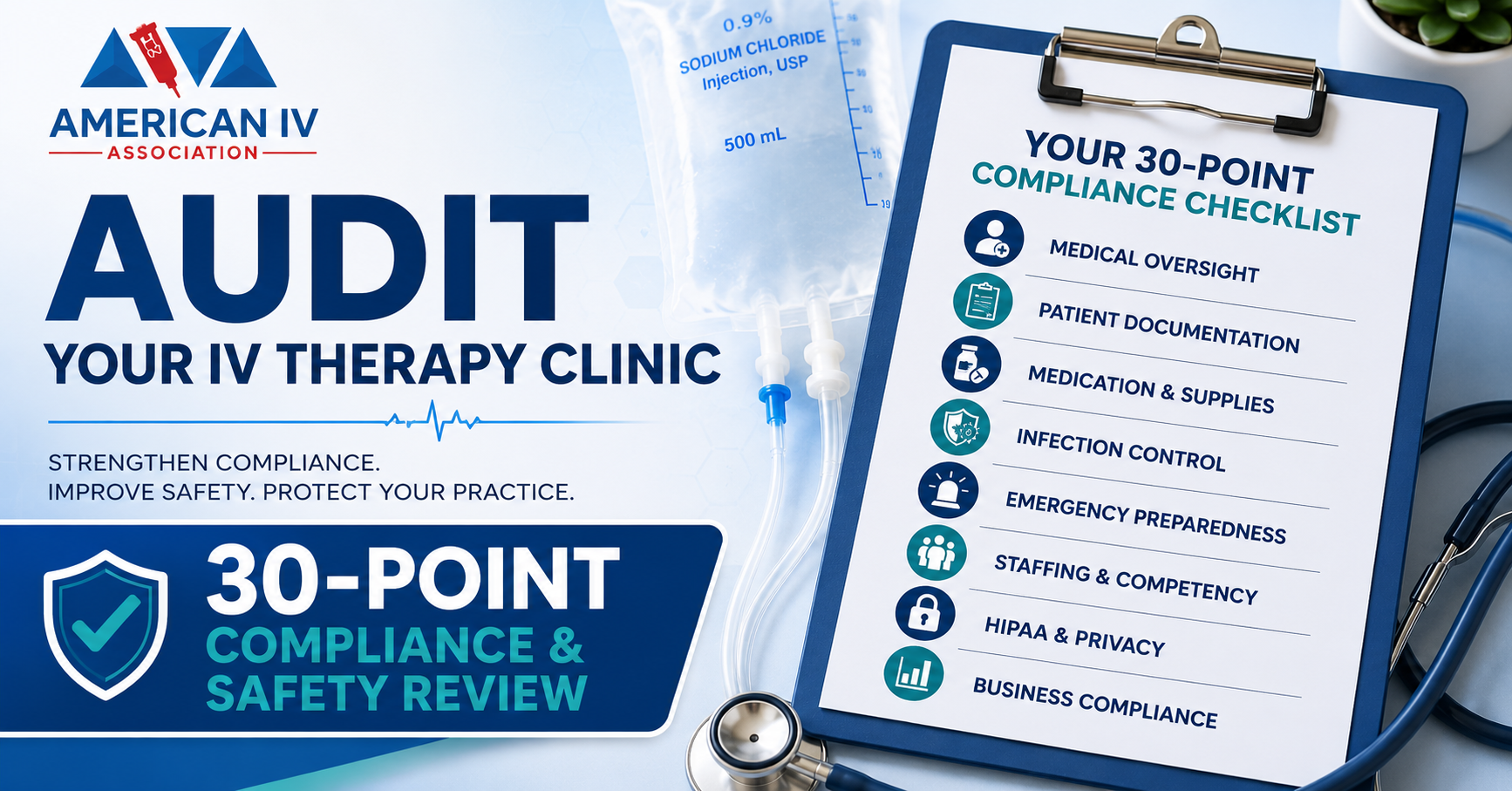
IV therapy clinics occupy a unique — and often precarious — regulatory space. They deliver medical-grade interventions (prescription medications, controlled fluids, injectable vitamins) but frequently operate with the staffing model and consumer-facing feel of a spa or wellness studio. That gap between clinical risk and operational reality is exactly where lawsuits, board complaints, and state inspections happen — which is why a regular IV therapy clinic compliance audit isn’t optional overhead, it’s the single best insurance policy you can run yourself.
Whether you’re a clinic owner preparing for a state health department visit, a medical director doing a quarterly self-check, or an investor conducting due diligence before acquiring a clinic, a structured audit is the fastest way to find your exposure before someone else does.
Below is a 30-point review organized into six categories: Licensing & Governance, Staffing & Credentialing, Clinical Protocols, Medication & Supply Management, Facility & Infection Control, and Documentation & Patient Rights.
1. Licensing & Governance
1. Business and facility licensing is current and displayed. Confirm your state business license, local health permit, and any medical facility license (where required) are active and posted where regulations require.
2. Medical director is properly designated and engaged. Most states require a licensed physician (or in some states, an NP/PA with appropriate authority) to serve as medical director. Verify this isn’t a name-only arrangement — check for evidence of actual oversight: signed protocols, periodic chart reviews, and documented availability.
3. Standing orders and collaborative practice agreements are current. If nurses are administering IVs under standing orders or a collaborative agreement, confirm the document is signed, dated within the required renewal window, and matches what’s actually being practiced.
4. Scope-of-practice alignment by state. IV therapy regulation varies enormously by state — some restrict who can assess patients, prescribe additives, or run a clinic without on-site physician presence. Re-verify your model against current state nursing and medical board rules, not just what was true when you opened.
5. Business liability and malpractice insurance are active and adequate. Check coverage limits against your actual patient volume and service complexity (e.g., NAD+ infusions and high-dose vitamin protocols carry different risk profiles than basic hydration).
6. Corporate practice of medicine (CPOM) compliance. In CPOM states, confirm your ownership and management structure doesn’t run afoul of restrictions on non-physicians controlling clinical decision-making.
2. Staffing & Credentialing
7. All clinical staff licenses are verified and unexpired. Pull current license status directly from your state’s board lookup — don’t rely on a photocopy an employee handed you at hiring.
8. Credential files are complete. Each clinician’s file should include license, applicable certifications (ACLS/BLS at minimum for anyone administering IV push medications), and proof of required continuing education.
9. IV certification matches state requirements. Some states require a specific IV therapy certification course beyond base nursing licensure. Confirm staff hold it if applicable.
10. Staff-to-patient ratios and supervision levels meet protocol. If your standing orders require a nurse to be within a certain proximity of a physician or NP during specific procedures, verify staffing schedules actually reflect that.
11. Background checks and employment eligibility are on file. Especially important given access to controlled substances and vulnerable patients.
12. Ongoing competency assessments are documented. Annual skills checks (venipuncture, anaphylaxis response, code protocols) should be dated and signed, not assumed.
3. Clinical Protocols
13. Written protocols exist for every service offered. Every IV formula, injectable, and add-on should have a corresponding written protocol specifying indications, contraindications, dosing, and administration method.
14. Pre-treatment screening process is consistently applied. Review a sample of charts: was a health history and contraindication screen (pregnancy, kidney disease, cardiac conditions, allergies) actually completed before infusion, every time?
15. Informed consent is obtained and specific. Generic “I consent to treatment” forms are a common weak point. Consent should name the specific substances, risks, and alternatives for that service.
16. Vital signs and baseline assessment before infusion. Confirm this is protocol and that charts show it happened, not just that the form has a blank field for it.
17. Emergency response protocol is written, posted, and drilled. There should be a specific, step-by-step anaphylaxis/adverse-reaction protocol, and staff should be able to describe it without looking it up.
18. Emergency equipment is stocked, checked, and logged. Epinephrine, oxygen, and a documented crash cart/kit checklist with regular (ideally monthly) expiration and inventory checks.
19. Physician availability during treatment hours is real, not nominal. If protocols require physician availability by phone or in-person within a defined time, test whether that’s actually achievable during all open hours, including evenings/weekends.
20. Adverse event reporting and follow-up process exists. Confirm there’s a defined process for logging, escalating, and following up on any adverse reaction — and that it’s actually been used when needed.
4. Medication & Supply Management
21. Controlled substance and prescription medication handling meets DEA/state rules. If any additives are controlled or prescription-only, verify storage (locked, limited access), logging, and waste documentation.
22. Medication sourcing is from licensed, traceable suppliers. Confirm you’re not sourcing from unlicensed compounding sources or gray-market vendors — a growing focus area for state boards given IV/vitamin injectable shortages.
23. Compounded medications meet USP <797> or state equivalent standards. If you compound anything on-site or receive compounded products, check the sterility and beyond-use-date documentation.
24. Inventory tracking includes lot numbers and expiration dates. This matters both for day-to-day safety and for your ability to respond quickly to a recall.
25. Expired or damaged supplies are quarantined and disposed of per protocol. Physically check storage areas during the audit — don’t just review a log.
5. Facility & Infection Control
26. Infection control protocols meet current CDC/state guidance. Hand hygiene, PPE use, and site prep procedures should be written, posted, and observably followed.
27. Sharps and biohazard disposal is compliant. Verify contracts with a licensed medical waste disposal service and that containers aren’t overfilled or improperly stored.
28. Treatment areas support real privacy and cleanliness standards. Between-patient cleaning protocols should be documented, and treatment chairs/rooms should allow the level of privacy your state requires for the procedures performed.
6. Documentation & Patient Rights
29. Patient records meet retention and security requirements (HIPAA and state law). Check that your EHR or paper system meets encryption/access-control standards and that retention periods match state minimums (often 7+ years, longer for minors).
30. Billing and marketing claims match actual scope of practice and evidence. This is an increasingly active enforcement area: claims about “detox,” “immune boosting,” or anti-aging benefits should be reviewed against FTC substantiation standards, and billing codes should match services actually rendered and permitted under your license structure.
Turning the Checklist Into a Practice
A one-time audit is a useful snapshot, but the clinics that stay out of trouble treat this as a recurring cycle:
- Quarterly: Spot-check charts (aim for at least 5–10% of volume) against items 13–20.
- Semi-annually: Full credential and licensing re-verification (items 7–12).
- Annually: Full 30-point review, ideally with an external consultant or healthcare attorney who isn’t invested in finding “everything’s fine.”
If you’re preparing for an actual state inspection or accreditation review, it’s worth having a healthcare compliance attorney or consultant walk through this list with you before regulators do — the cost of a proactive audit is a fraction of the cost of a corrective action plan, a suspended license, or a malpractice claim.
Want This Audit Done For You, Every Quarter?
Staying compliant isn’t a one-time project — it’s an ongoing discipline, and most clinic teams don’t have the bandwidth to chase state board updates, re-verify licenses, and spot-check charts on top of running daily operations.
Become a Member and get:
- ✅ Full 30-point audit templates (editable, ready to use for self-audits or inspections)
- ✅ Quarterly compliance updates as state IV therapy regulations change
- ✅ Credentialing and license-renewal reminders so nothing lapses unnoticed
- ✅ Access to sample protocols, consent forms, and emergency response templates
- ✅ Priority access to our network of healthcare compliance attorneys and consultants
Already convinced? Become a Member today and get your first audit toolkit instantly.
For additional IV therapy compliance forms, templates, and business resources, visit the IV Books & Forms library.