
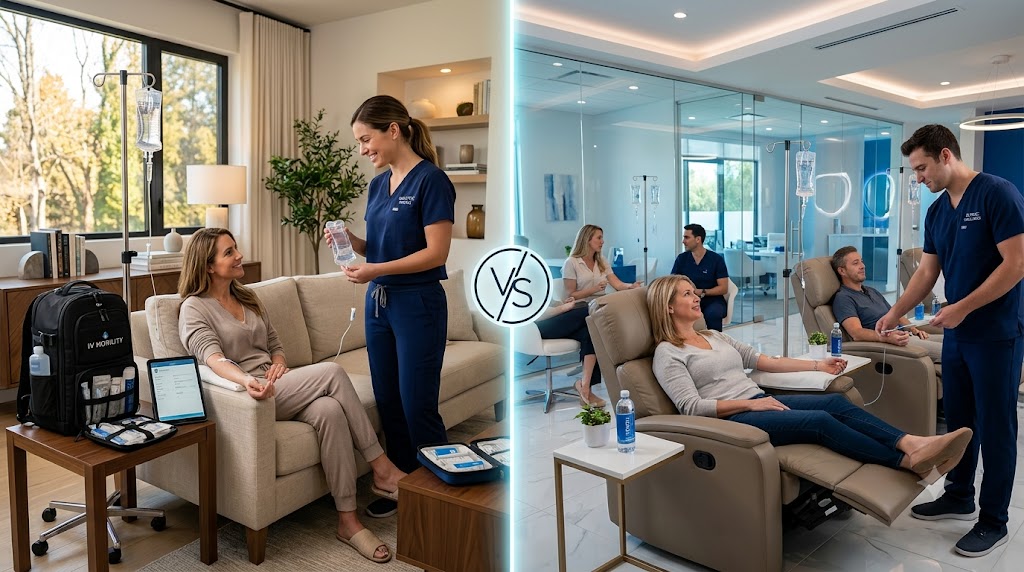
One of the first decisions anyone entering the IV hydration industry has to make isn’t about drip formulas or branding — it’s whether to build a mobile IV therapy business or open a storefront clinic. Get this decision right early, and everything downstream (staffing, licensing, marketing, cash flow) gets easier. Get it wrong, and you’ll find yourself retrofitting a business model that was never built for how you actually want to operate.
There’s no universal right answer — mobile IV therapy vs. storefront clinic is really a question of your market, your capital, and how you want to spend your time. Here’s how to think through it.
Not sure which model fits your market? AIVA members get access to founding members running both models successfully, plus guidance to help you decide.
Startup Costs: Lower Barrier vs. Bigger Investment
Mobile IV therapy generally has a lower barrier to entry. You’re not paying for a lease, buildout, or waiting room furniture — your primary costs are a reliable vehicle (or a fleet, as you scale), medical supplies, insurance, licensing, and a booking/dispatch system. Many mobile operators launch with a single nurse and a car before reinvesting profits into growth.
Storefront clinics require significantly more upfront capital: lease deposits, buildout and design, medical-grade furniture and infusion chairs, signage, and often a larger initial supply order. In exchange, you get a physical presence that supports walk-in traffic, local SEO (Google Business Profile and map-pack visibility), and a brand identity that’s harder to build with a purely mobile model.
The takeaway: if capital is your biggest constraint, mobile is the faster path to revenue. If you have access to funding and want to build long-term brand equity in a specific location, a storefront may be worth the bigger initial investment.
Staffing and Labor Efficiency
Mobile IV therapy labor economics work differently than a clinic’s. A mobile nurse typically completes fewer visits per shift than a clinic-based nurse would see clients, because drive time between appointments eats into billable hours. Route density (how many clients you can reasonably serve in one geographic area per shift) becomes a critical metric — mobile operators in sprawling suburban markets often see lower nurse utilization than those in dense urban areas.
Storefront clinics get more infusions per nurse per shift since there’s no travel time between clients, and multiple infusion chairs allow one nurse to monitor several drips simultaneously. This generally makes staffing more labor-efficient per visit, though it comes with fixed labor costs (someone has to be on-site during all open hours, regardless of walk-in volume).
Curious how staffing ratios compare across both models? Join AIVA and tap into a network of owners who’ve solved this exact staffing puzzle.
Regulatory and Compliance Differences
Both models fall under the same core requirements covered in most states’ scope of practice and medical director rules — but mobile operators face a few additional considerations:
- Service area licensing: Some states require mobile operators to register or notify the state of service areas, particularly if you’re crossing county or state lines.
- On-site safety protocols: Mobile nurses need clear emergency protocols since they don’t have a clinic’s controlled environment or immediate backup — including transport plans for adverse reactions.
- Storage and transport of medications/supplies: Proper handling of vitamins, saline, and any controlled substances in a vehicle requires documented protocols that clinic-based models don’t need to think about as heavily.
Storefront clinics, by contrast, deal more heavily with facility-specific requirements: ADA compliance, biomedical waste disposal contracts, and local business licensing/zoning approval for medical use of the space.
Whichever model you choose, the ownership and medical director requirements don’t disappear — they just apply differently. AIVA’s Compliance Corner helps members navigate both.
Marketing and Client Acquisition
Mobile IV therapy tends to lean heavily on convenience-driven marketing: same-day or on-demand booking, targeted local ads, and partnerships with hotels, event venues, and corporate wellness programs. Client acquisition often comes through digital channels — social media, paid search for “IV therapy near me,” and referral partnerships — since there’s no physical storefront to generate walk-in awareness.
Storefront clinics benefit from local SEO and map-pack visibility, foot traffic, and the credibility that comes with a physical location clients can see and visit. Clinics also tend to perform better with membership-driven repeat business, since it’s easier to build a habitual “come in on your lunch break” pattern than to coordinate a recurring mobile visit.
Scalability: Which Model Grows Faster?
Mobile IV therapy businesses often scale faster in the early stages — adding a second nurse and vehicle is a smaller capital commitment than opening a second location. This makes mobile an attractive model for expanding into new geographic markets quickly.
Storefront clinics scale differently: growth usually means adding locations, which requires replicating the entire buildout, staffing, and lease process each time — slower, but each location tends to build more durable, location-based brand equity and repeat client relationships over time.
Many successful operators eventually blend both models — a flagship storefront location paired with a mobile fleet that extends reach into surrounding areas without the cost of additional buildouts. This hybrid approach captures the brand equity of a physical presence while retaining the flexibility and lower incremental cost of mobile expansion.
A Side-by-Side Comparison
| Factor | Mobile IV Therapy | Storefront Clinic |
|---|---|---|
| Startup cost | Lower — vehicle, supplies, insurance | Higher — lease, buildout, furniture |
| Labor efficiency | Lower visits/shift due to travel time | Higher visits/shift, multiple chairs per nurse |
| Client acquisition | Digital/on-demand, convenience-driven | Local SEO, walk-in traffic, brand presence |
| Compliance focus | Transport, storage, service-area rules | Facility licensing, zoning, ADA/biomedical waste |
| Scalability | Faster, lower cost per expansion | Slower, higher cost, stronger brand equity per location |
| Best fit for | Owners with limited capital, dense urban markets, or event/corporate focus | Owners with access to capital wanting a durable local brand |
A Decision-Making Checklist
- Assess your available capital. Can you realistically fund a lease and buildout, or does a lower-overhead mobile launch make more sense right now?
- Study your local market density. Mobile route efficiency depends heavily on how spread out your target clients are.
- Map your state’s specific requirements for each model — mobile and storefront compliance obligations aren’t identical.
- Consider your long-term brand goals. Do you want a recognizable local presence, or are you optimizing for flexibility and lower fixed costs?
- Model both scenarios’ staffing economics before committing — visits per shift and nurse utilization will differ significantly between the two.
- Don’t rule out a hybrid model as you grow — many of the most successful AIVA members eventually run both.
The Bottom Line
Mobile IV therapy vs. storefront clinic isn’t a question with one right answer — it’s a question of your capital, your market, and the kind of business you want to build. Mobile gets you to revenue faster with less upfront risk; a storefront builds durable brand equity and labor efficiency at a higher initial cost. Understanding the tradeoffs before you commit is what separates owners who scale smoothly from those who spend their first year retrofitting the wrong model.
Become an AIVA Member today and gain access to the tools, education, and expert guidance designed specifically for IV hydration business owners.
👉 Join today and grow your IV therapy business with confidence.
Get Business Model Guidance Built for IV Therapy Owners
Choosing between mobile and storefront — or building a hybrid — shouldn’t be a guessing game. AIVA membership gives you:
- Direct access to founding members running mobile, storefront, and hybrid models
- Attorney-led Compliance Corner guidance covering both business models
- A vetted network of medical directors, vendors, and industry partners
- Ongoing education to help you launch and scale with confidence
Join AIVA today and get the guidance you need to choose the right model and grow with confidence.
Start building a stronger, more successful IV therapy business today.